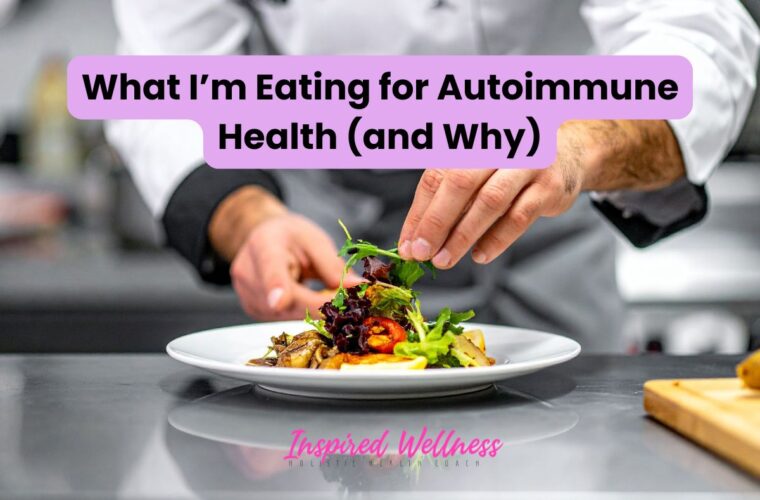
Over the past few weeks, I’ve been intentionally getting back to the eating habits that help me feel my best. Like many women living with autoimmune disease, I don’t eat perfectly every day. Life happens. Stress happens. Travel happens. But I’ve learned that every meal is a new opportunity to nourish my body instead of striving for perfection. Today I want to show you what I’m eating right now—and more importantly, why I choose these foods.
There is a lot of information in the world about what’s best to eat when you have an autoimmune condition. Some of it is conflicting and may leave you wondering, “What am I supposed to eat?” You’re not alone. I’ve been there too.
What I’ve Learned
When I was first learning about nutrition and autoimmune health, I wanted someone to hand me the perfect meal plan that would fix everything. But over time, I discovered that healing wasn’t about finding the “perfect” foods. It was about learning how to consistently make choices that support my body rather than work against it. We must keep in mind that all people are different.
Even today, I don’t eat perfectly.
In fact, I tend to go in cycles when I fall completely off the wagon then eventually get back on. I’m not proud of this fact, but I’m being honest with you. I am not perfect in this or any area!
However, over the past several weeks, I’ve been intentionally getting back to the habits that help me feel my best. Life has seasons. Sometimes we’re more consistent than others. What matters most isn’t perfection – it’s returning to the habits that nourish us whenever we’ve drifted away.
That’s why I wanted to share what I’m eating right now—and more importantly, why I’m choosing these foods.
Food Is Information
It starts in my brain. One of the most helpful mindset shifts I ever made was realizing that every meal sends information to my body.
Food doesn’t simply fill our stomach, it communicates with our cells.
It influences blood sugar, energy production, gut health, inflammation, and even how we feel emotionally throughout the day.
That doesn’t mean one meal determines your health. But thousands of meals over time absolutely influence it.
Instead of asking, “Is this food good or bad?” I now ask myself:
“How will this meal help my body today?”
That simple question has changed everything.
What I’m Prioritizing Right Now
Rather than following rigid rules or a specific diet plan, I’m focusing on a few simple principles.
- I’m making protein a priority because it helps stabilize blood sugar, supports muscle health, and keeps me satisfied longer. As we age, muscle loss and declining bone density are very important factors to consider. Adequate protein helps protect lean muscle and bone. How much is enough?
- I encourage .7 to 1.0 grams of protein per pound of ideal body weight. I utilize the higher end. You can talk to your doctor or RD about what’s right for you. Other factors like age, activity level kidney health and other medical conditions may play a role in what’s right for you.
- I like to initially weigh my protein and track it in My Fitness Pal (there are several nutrition apps to choose from) to make sure I’m getting enough and learning what “enough” looks like. You won’t have to track your food forever but it is an enlightening and educational process to start with.
- Getting adequate protein requires eating protein at every meal and snack. Again, tracking protein teaches me what that looks like.
- I’m choosing plenty of colorful vegetables because they provide vitamins, minerals, fiber, and protective plant compounds that help support overall health.
- I’m choosing healthy fats like avocado, olive oil, nuts, and seeds because they’re important for overall wellness and help meals feel satisfying.
- Whenever possible, I’m limiting processed foods and choosing ingredients that are closer to the way God created them. One easy way to think about this principle is shopping the perimeter of the grocery store. This includes meat, dairy, produce, etc. The middle aisles of the grocery store are generally more processed food.
None of these choices are about restriction. They’re about nourishment.
You’ll likely find that adding all these things leaves little room for processed food and sweets. The idea is to think about what’s good for your body and you won’t miss the other things.
Small Choices Add Up
Healing isn’t built on one perfect day of eating. It’s built through hundreds of ordinary choices made consistently over time.
Sometimes the healthiest choice is preparing a simple meal instead of fast food. In reality, when you consider the travel time and fuel, wait time and cost, it REALLY is easier and faster to make a simple nutritious meal at home!
Examples of Small Healthy Choices
Plan your daily protein to meet your optimal level.
Add one more serving of vegetables to your day.
Drink more water.
Begin again after a difficult week.
Those small choices matter far more than most people realize.
A Spiritual Perspective
Scripture reminds us:
“Whether you eat or drink, or whatever you do, do it all for the glory of God.” (1 Corinthians 10:31)
For me, eating well isn’t about earning health.It’s about stewardship.
God has entrusted each of us with a body that carries us through this life. Caring for it isn’t about fear or striving. It’s one way we honor the gift we’ve been given.
There is tremendous freedom in approaching food from gratitude instead of guilt.
One More Learning Takeaway
Healthy eating doesn’t happen by accident. I’ve learned that It happens because I make a plan. If I don’t know what I’m eating before I’m hungry, I’m much more likely to make choices that don’t support how I want to feel. We’ll talk more about systems and planning in a future blog, but for now, I simply encourage you to take five minutes this week and think through tomorrow’s meals. Your future self will thank you.
One Simple Step This Week
Instead of trying to overhaul your entire diet, choose just one meal each day and intentionally ask:
“How can I make this meal a little more nourishing?”
Maybe you add protein.
Maybe you include another vegetable.
Maybe you replace a processed snack with cottage cheese or fruit and nuts.
Small, consistent improvements are what create lasting change.
Final Encouragement
If you’re feeling overwhelmed by nutrition, take a deep breath. You don’t have to get everything right today. You don’t have to eat perfectly. You can simply make your next choice a little more nourishing than your last.
It’s about faithfully making small decisions that support your body, your mind, and your spirit—one meal at a time.
And remember, you don’t have to walk this journey alone. I’ve been where you are, and I want you to know that hope is real. In my health journey, proper nutrition was the pivotal point of my return to health and vitality as I found remission from my condition. I shared all the details in my book, Faithful Autoimmune Remission.
Lifestyle medicine, combined with the care of your medical team, can become a powerful part of helping you live a vibrant, hope-filled life.
Wishing you a full and vibrant life!
Terri