I’ll admit something: I haven’t always been a big fan of strength training.
I knew it was something I should do, but given the choice, there were other ways I’d much rather move my body.
Then something changed. I sustained a serious ankle injury that left me in a boot for a month and a brace after that. My movement took a nose dive.
Something even more concerning happened. I began noticing that I was losing strength and mobility. Honestly, that scared me.
It wasn’t about how my body looked. It was about what my body could do—and what might happen in the years ahead if I continued losing strength.
That realization flipped the script in my head.
Instead of thinking, I should strength train because it’s good for me, I started thinking about the life I want to keep living.
I want to stay active. I want to move well. I want to travel, enjoy the outdoors, carry things, get up and down easily, and maintain my independence as I age.
Suddenly, strength training had a purpose. Not just a purpose but it became a requirement for me to continue living the life I choose.
And once I understood the why, my next question became: How can I make this something I actually enjoy enough to do consistently?
That’s when strength training began to change for me.
And if you’ve never considered yourself a “strength-training person,” I want to help flip the script for you, too.
Because as we age, strength training isn’t primarily about building impressive muscles or lifting the heaviest weights. It’s about building strength for the life we want to keep living.
Muscle Becomes More Important as We Age
Beginning in adulthood, we gradually lose muscle mass, strength, and power as we age. That decline can eventually affect the ordinary things we rarely think about when we’re younger—getting out of a chair, climbing stairs, carrying groceries, lifting a suitcase, gardening, or getting down on the floor and back up again.
That’s why I like to think about strength training as building capacity for your future.
We aren’t simply exercising for today. We’re helping our bodies remain capable of doing the things we want them to do tomorrow.
What Counts as Strength Training?
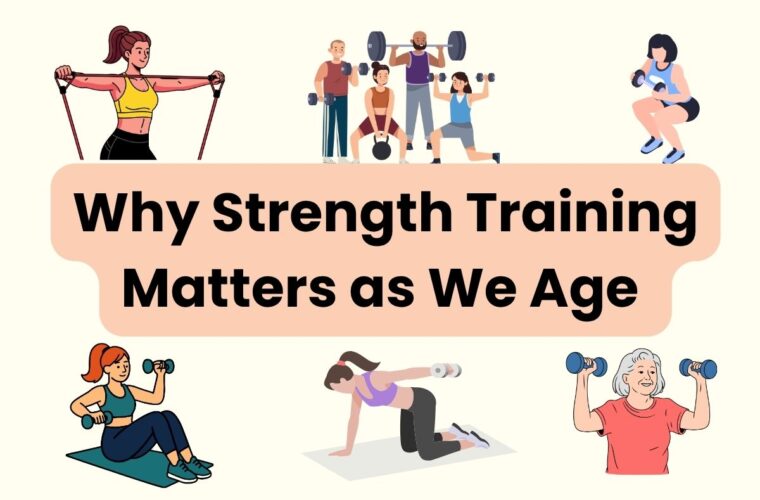
Strength training—also called resistance training—simply means asking your muscles to work against resistance.
That resistance might come from:
- Dumbbells or other weights
- Resistance bands
- Weight machines
- Your own body weight
You don’t have to become a “weightlifter” to become stronger.
The goal is to challenge your muscles appropriately and, over time, gradually increase that challenge as your body adapts.
U.S. Government current physical-activity guidelines recommend that adults include muscle-strengthening activity involving the major muscle groups at least two days per week, in addition to aerobic movement. I recommend at least three days per week, and four if possible.
In other words, walking and strength training aren’t competitors.
They do different jobs, and both belong in a well-rounded approach to movement.
What About Autoimmune Disease?
This is where I want to add an important distinction.
Having an autoimmune condition doesn’t automatically mean you shouldn’t strength train—but it may mean your starting point, recovery needs, or progression looks different from someone else’s.
Your capacity may even look different from one week to the next. That isn’t failure. It’s information.
Rather than approaching strength training with an all-or-nothing mindset, learn to work with your body.
A Simple Way to Begin
If strength training is new to you, think about these five steps:
1. Learn the movement.
Good technique comes before heavier resistance.
2. Choose appropriate resistance.
Your muscles need some challenge, but you don’t need to exhaust yourself to make progress.
3. Train your whole body.
A balanced routine addresses the major muscle groups rather than focusing only on one area.
4. Allow recovery.
Strength isn’t built only while you’re exercising. Your body also needs time to recover and adapt.
5. Progress gradually.
As exercises become easier, resistance, repetitions, sets, or other training variables can gradually change.
If you have significant pain, mobility limitations, osteoporosis or fracture concerns, recent injury or surgery, dizziness, cardiopulmonary symptoms, or other medical considerations, talk with your healthcare professional or an appropriately qualified rehabilitation or exercise professional about what is safe for you.
Train for Your Future
Strength training can sometimes feel intimidating—especially if your mental picture involves crowded gyms and heavy barbells. I’d encourage you to change the picture.
Picture yourself carrying your own groceries.
Getting up from the floor.
Climbing the stairs.
Traveling.
Gardening.
Playing with grandchildren.
Continuing to do the things that make your life your life.
That’s what you’re training for.
Walking helps us keep moving. Strength training helps us build the physical capacity to keep doing the things we love.
You don’t need to start big. You simply need to start where you are, challenge your body appropriately, recover well, and build gradually.
It’s an investment in the life you want to keep living.